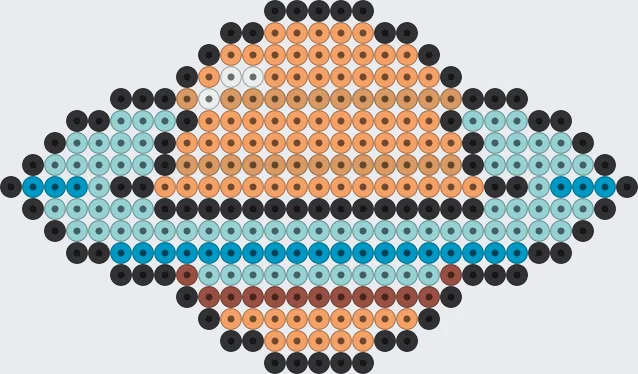
| Size | 29 × 17 beads |
|---|---|
| Colours | 7 · Perler |
| Total beads | 293 |
| Difficulty | Intermediate (3/5) |
| Finished size | 5.7 × 3.3 in (14.5 × 8.5 cm) |
| Pegboards | 1 square 29 × 29 board |
| Licence | CC BY-NC 4.0 — free for personal use with credit |
Materials
About this design
The planet is a round Apricot globe with two Butterscotch bands and a couple of White beads for a shine at the top left. A wide ring circles it at the equator: it disappears behind the planet at the top and sweeps across the front at the bottom, where a single row of Rust beads shows the ring’s shadow on the surface. The ring is Toothpaste with a Turquoise stripe running through it, and both ends stick well out past the planet to make the shape easy to recognise.
Bead counts: 81 Black, 76 Apricot, 70 Toothpaste, 25 Butterscotch, 25 Turquoise, 13 Rust and 29 White.
Placing the beads
The planet is 29 beads wide, the full width of a large square pegboard, and 17 rows tall. Start with the black lines where the ring meets the planet, because they set where everything else goes. Fill the front of the ring next, then the planet bands above and below it, and finish with the outer outline. The ring tips are narrow, so check each bead there is sitting straight.
Ironing and finishing
Rated 3 for the careful counting rather than the ironing. Even so, ironing is for an adult: medium heat, ironing paper and slow circles, giving the thin ring tips enough time to fuse. Flip and iron the back, then cool under a book so it stays flat. At about 14.5 × 8.5 cm it suits a space-themed bedroom wall, and a row of planets in different colours makes a mobile.
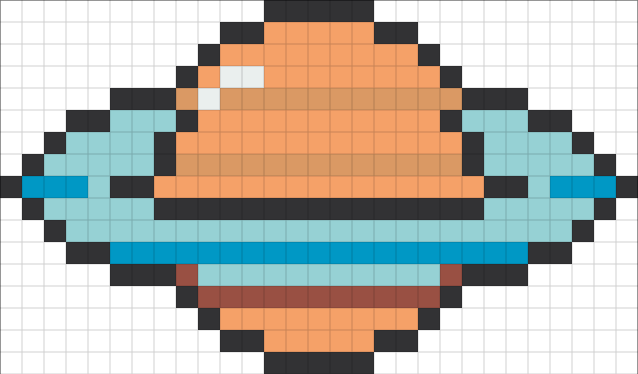
Colour plan
Perler 80-19018 Black does the most work, 28% of the 293 beads, followed by Perler 80-15213 Apricot at 26%. Perler 80-19001 White (3) is used only a little: small details worth marking on the chart so you don't miss them. 41% of the grid is left empty.
Working notes
All the beads touch along a full side, so it irons into one solid piece.
Hama and Artkal S equivalents
The nearest Hama and Artkal S colour for each Perler colour in this pattern, measured as ΔE 2000: up to 3 is very close, up to 6 close, up to 10 approximate.
| Perler | Hama | Artkal S |
|---|---|---|
| 80-19018 | H18 ΔE 9.6 · approximate | S13 ΔE 2.9 · very close |
| 80-15213 | H105 ΔE 3.1 · close | S18 ΔE 7.4 · approximate |
| 80-19001 | H01 ΔE 3.1 · close | S01 ΔE 3.3 · close |
| 80-19090 | H105 ΔE 7.6 · approximate | S68 ΔE 4.3 · close |
| 80-19058 | H97 ΔE 12.5 · no good match | S30 ΔE 3.7 · close |
| 80-19062 | H31 ΔE 3.9 · close | S100 ΔE 2.9 · very close |
| 80-19020 | H111 ΔE 7.8 · approximate | S15 ΔE 4.1 · close |
This is an original CraftPatterns design, licensed CC BY-NC 4.0: stitch it, share it and gift what you make — please credit craftpatterns.app and don't sell the pattern itself. Want to change it? Open it in the fuse beads editor.
Last updated · About us