Palettes: DMC, Anchor · 5–40 knots wide · up to 8 colours
Free alpha bracelet patterns to start with



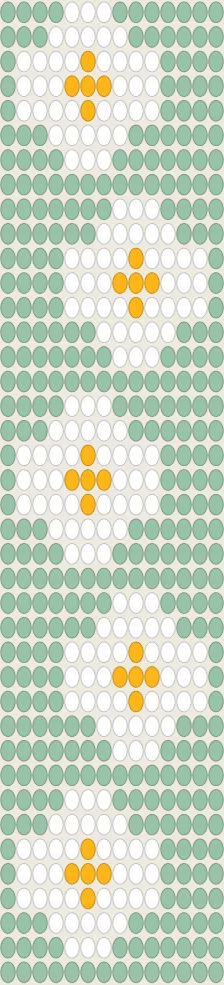
Alpha bracelets in a nutshell
An alpha bracelet is a friendship bracelet with a picture or a word knotted into it. Instead of tying diagonal knots across all the strings, you lay out a set of base strings and tie a working colour across them, one knot per square of the chart. Each knot behaves like a pixel, which is why alpha patterns can spell names, show tiny hearts and animals, or repeat a simple motif along the band.
They are popular with teenagers swapping bracelets with friends, with camp and club leaders who need a quick craft for a group, and with makers who sell personalised name bands. A finished alpha bracelet looks neat and graphic, but the planning is fiddly by hand: you need the right number of strings, the rows to go round a wrist, and a chart that reads correctly when knotted.
Getting the proportions right
The most important thing to know is that knots are not square. In six-strand floss each one is a little taller than it is wide, roughly 1.3 mm across and 2 mm per row, and tighter knots get taller still. A letter drawn on ordinary square graph paper comes out slightly stretched lengthways when knotted. The charts here are drawn to that knot shape, so what you see on screen is close to what ends up on your wrist.
Width is counted in knots across. Narrow bands of 8 to 12 knots suit a single short word in a small font; wider bands of 16 to 20 give room for a border or a two-colour picture. The default of 18 knots is roughly 2.3 cm wide in six-strand floss.
Length is counted in rows. At about 2 mm per row, a typical wrist needs somewhere around 75 to 95 rows of pattern. The bracelet length calculator works it out from a wrist measurement and also tells you how long to cut each base string.
Colours should be few. Two to four colours is the sweet spot: a background, a letter colour and perhaps a border. Each extra colour adds another working string to manage. You can set anywhere from 2 to 8.
What the tools do for you
- Text to alpha pattern is the one most people start with. Type a name or word, pick the Basic, Serif or Tiny font, choose Sideways to have it read along the bracelet, and set the width to the knots across you want. Borders such as single lines, dots or hearts are optional.
- Photo to alpha pattern turns a small, simple image such as an icon or logo-style drawing into a knot chart. Because bracelets are narrow, bold shapes with few colours convert best.
- Alpha pattern editor is for drawing your own motifs, adjusting a letter that came out awkward, or mirroring a design so both ends of the bracelet match.
Every chart comes with written row-by-row instructions, starting from row 1 at the top, plus a count of base strings and working colours. The PDF includes those instructions alongside the chart, so you can keep it beside you while you knot. The alpha bracelet basics guide explains the knots themselves if you are new to the technique.
Common mistakes
- Using square graph paper. Letters come out wide and squat. Use a chart drawn with real knot proportions.
- Miscounting base strings. A pattern N knots wide needs N base strings, one per knot. Counting them before you tie on saves unpicking a whole row.
- Cutting base strings to the bracelet length. You need extra for the ties at each end; many makers add around 30 cm.
- Too many colours in a narrow band. Each colour is another working string, and carrying several behind the base strings makes the back bulky.
- Starting from the wrong end. Row 1 is the top of the chart; starting from the bottom mirrors letters.
How to start
- Measure your wrist and decide how wide you want the band.
- Type the name in the text tool, choose the Sideways layout and set the width.
- Pick two or three thread colours with clear contrast.
- Use the calculator to get the number of rows and the cut length for each base string.
- Download the PDF with the written rows, cut your strings, and start knotting from row 1.
Alpha bracelets guides
Frequently asked questions
What is the difference between alpha and normal friendship bracelets?
Normal patterns, such as chevrons and candy stripes, are made by knotting diagonally across all the strings. Alpha patterns use a set of base strings that run the length of the bracelet, with a working colour knotted across them row by row, so each knot acts like a pixel. That is what makes letters and small pictures possible.
How many strings do I need for an alpha bracelet?
One base string per knot across, so a chart 12 knots across uses 12 base strings. On top of that you need one working string for each colour in the design. The tools show both numbers next to the chart.
Why are the chart squares taller than they are wide?
They are drawn to the real shape of a knot, which in six-strand floss is a little taller than it is wide (roughly 1.3 mm across and 2 mm per row). Drawing the chart that way shows the design in the proportions it will have on the finished bracelet.
Which row do I start knotting from?
Row 1 is the top row of the chart, the first row you knot under the clip. The written instructions list each row in order from there, so you work down the chart as the bracelet grows.
Can I make a name bracelet that reads along my wrist?
Yes. In the text tool, choose the Sideways layout. The lettering is rotated 90 degrees so the word runs along the length of the bracelet, and you can fix the width to the number of knots across you want.
Which embroidery floss colours do the patterns use?
Patterns use DMC® or Anchor® thread codes, the same six-strand embroidery floss most bracelet makers already own. Each colour in the key also shows the nearest code in the other brand.
Last updated · About us