Palettes: Generic pony beads · 3–60 beads wide · up to 20 colours
Free pony beads patterns to start with
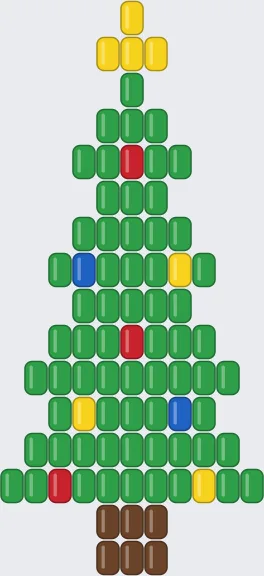
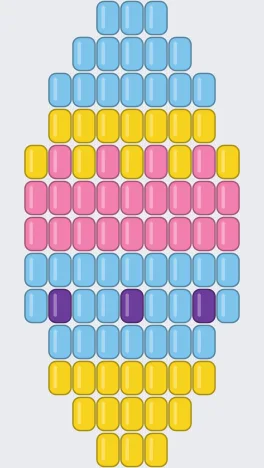
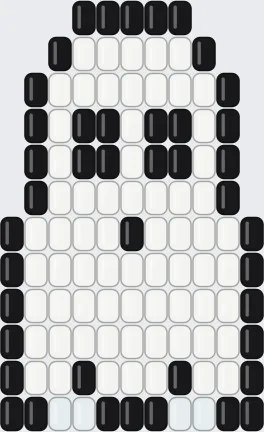
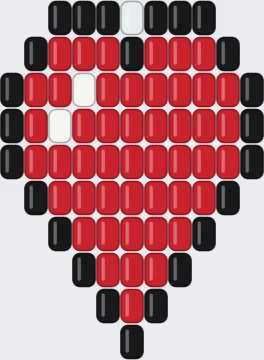
What pony bead lacing is
Pony beads are the chunky plastic beads with big holes that children string on cords and pipe cleaners. Laced flat, row by row, they make keychains, bag charms, zip pulls and small pictures. Each row is threaded on one end of the cord, and the other end goes back through the same beads from the other side, so the cords cross inside the row and hold it in place.
Because each row is one unbroken run of beads on the cord, pony bead charts follow a rule other bead charts do not: no gaps inside a row. A row also centres itself under the one above, so the best designs are built from rows that are centred on the chart. The tools here check both rules for you.
Size, colours and cord
Size. Keychains are usually 5 to 15 beads wide and 10 to 25 rows tall. With beads about 6 mm wide and 9 mm tall in the row, a 9-bead-wide, 15-row heart is roughly 5.4 cm wide and 13.5 cm long. Widths from 3 to 60 beads are supported.
Colours. Pony bead pictures are bold: three to six colours give the clearest result. The palette has 40 generic shades, including neons and transparents.
Cord. Every chart comes with a cord estimate. Start a keychain by folding the cord in half through a split ring, so both ends are the same length.
How the tools fit together
The photo to pony bead pattern maker turns a small picture into a laced chart. The pony bead name pattern maker sets names and initials on a solid background, ready to lace. The pony bead pattern editor lets you draw your own design bead by bead and warns you if a row has a gap.
Each PDF has a colour key with bead counts, the cord estimate, the chart drawn with tall bead-shaped cells, and every row written out from the top. Browse the free pony bead patterns for ready-made designs.
Common mistakes
- Gaps in a row. A space inside a row disappears when you pull the cord tight. Fill it with a background colour.
- Off-centre rows. A row centres itself under the row above, so a design that is not symmetrical row by row will shift.
- Stretchy cord. Elastic sags; use plastic lacing or satin cord.
- Cutting the cord too short. Use the estimate and add a little; joining cord halfway is fiddly.
- Pulling unevenly. Pull both ends by the same amount after each row so the piece stays straight.
Getting started
- Pick a pattern or open one of the tools.
- Keep to about 5 to 15 beads wide and 3 to 6 colours.
- Check the row list: no gaps, rows centred.
- Cut the cord to the estimate, fold it through a split ring and lace the first row.
- Lace each row in turn from the top and tie off under the last one.
Frequently asked questions
How are pony bead patterns made?
These charts are for the lacing method, also called the ladder or cross-over method. Thread a row of beads onto one end of the cord, then pass the other end through the same beads from the opposite side so the two ends cross inside the row. Pull both ends to lock the row, then lace the next row underneath.
Why can't a row have a gap?
The cord runs through every bead in a row, so an empty space would simply close up. The tools warn you when a row has a gap, and the text tool fills the space around letters with a background colour.
What size are pony beads?
Standard pony beads are usually sold as 6 × 9 mm: about 9 mm across and 6 mm long, with a hole of around 4 mm. In a laced row they lie on their side, so each bead is about 6 mm wide and 9 mm tall in the piece. Sizes vary a little between makers.
What cord should I use?
A cord that goes through a pony bead twice without stretching: plastic lacing (lanyard cord), satin cord or thin paracord. Elastic lets the rows sag.
How much cord do I need?
The tools estimate it from the chart: both ends pass through every row and drop about 9 mm to the next, plus about 50 cm for the top loop and tying off. Cut a little more than the estimate.
Which colours are in the palette?
Forty generic pony bead colours with our own names: opaque shades, five neons and three transparents. Pony beads are not sold by colour number, so match by eye to the beads you have.
Last updated · About us