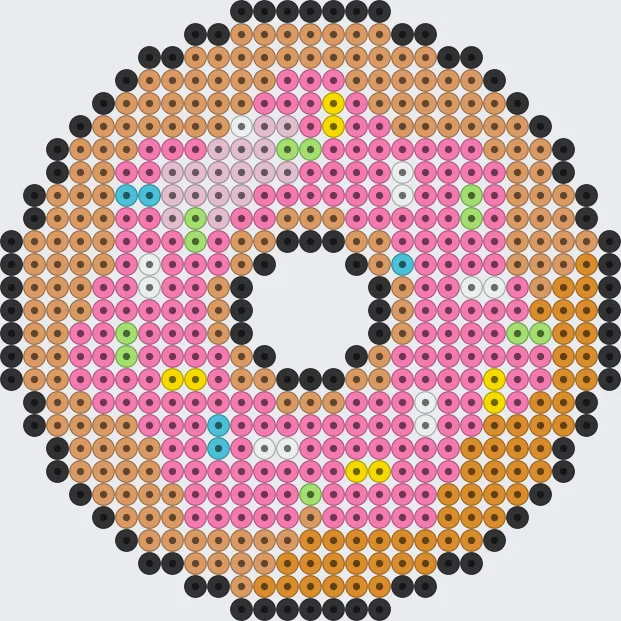
| Size | 27 × 27 beads |
|---|---|
| Colours | 9 · Perler |
| Total beads | 540 |
| Difficulty | Easy (2/5) |
| Finished size | 5.3 × 5.3 in (13.5 × 13.5 cm) |
| Pegboards | 1 square 29 × 29 board |
| Licence | CC BY-NC 4.0 — free for personal use with credit |
Materials
About this design
This is the classic top-down ring donut: a Butterscotch dough edge, a hole in the middle and Cotton Candy icing that ripples around the outside instead of ending in a neat circle. Honey beads along the lower right of the dough make it look rounded, and a little patch of Light Pink near the top of the icing works as a glossy highlight. Short two-bead sprinkles in White, Lemon, Sky and Sour Apple are scattered at different angles.
Bead counts: 184 Cotton Candy, 162 Butterscotch, 88 Black, 54 Honey, 17 Light Pink, 11 White, 11 Sour Apple, 8 Lemon and 5 Sky.
Placing the beads
The donut is 27 × 27, so it fills nearly all of a large square pegboard with one empty peg around the edge. Start with the black ring around the hole, then the outer black outline, then place the sprinkles before any icing — they are easier to position when the area around them is still empty. Fill the icing and finally the dough.
Ironing and finishing
As always, the iron is an adult’s job. Larger pieces like this need a little longer: work in sections under the ironing paper, about 10 to 20 seconds each, until all the beads have just merged. Flip and iron the back. Big round pieces like to dome as they cool, so put the donut under a heavy book straight away. At about 13.5 × 13.5 cm it is ideal as a coaster; a sheet of felt glued to the back stops it sliding on the table.
Colour plan
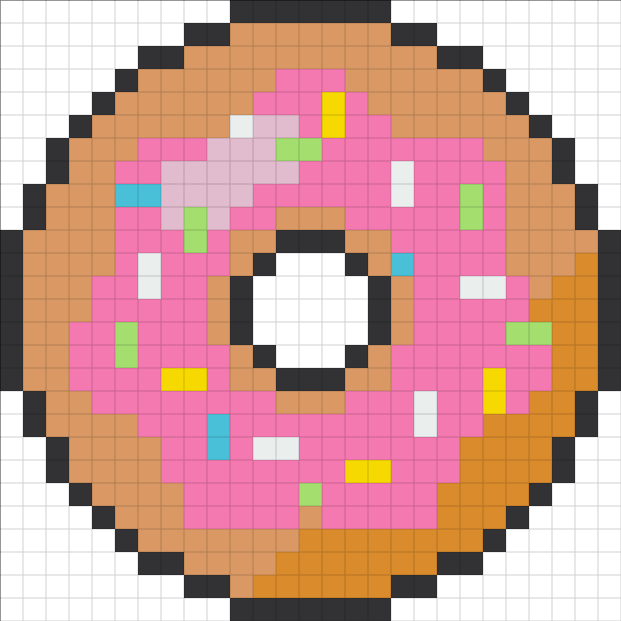
Perler 80-15242 Cotton Candy does the most work, 34% of the 540 beads, followed by Perler 80-19090 Butterscotch at 30%. Perler 80-15269 Lemon (8) and Perler 80-15216 Sky (5) are used only a little: small details worth marking on the chart so you don't miss them. 26% of the grid is left empty.
Working notes
All the beads touch along a full side, so it irons into one solid piece.
Hama and Artkal S equivalents
The nearest Hama and Artkal S colour for each Perler colour in this pattern, measured as ΔE 2000: up to 3 is very close, up to 6 close, up to 10 approximate.
| Perler | Hama | Artkal S |
|---|---|---|
| 80-19018 | H18 ΔE 9.6 · approximate | S13 ΔE 2.9 · very close |
| 80-19090 | H105 ΔE 7.6 · approximate | S68 ΔE 4.3 · close |
| 80-15242 | H06 ΔE 6.2 · approximate | S40 ΔE 3.7 · close |
| 80-15269 | H03 ΔE 4.4 · close | S14 ΔE 5.3 · close |
| 80-19001 | H01 ΔE 3.1 · close | S01 ΔE 3.3 · close |
| 80-19079 | H95 ΔE 10.8 · no good match | SE7 ΔE 4.4 · close |
| 80-15241 | H47 ΔE 9.5 · approximate | S55 ΔE 7.1 · approximate |
| 80-15216 | H49 ΔE 6.9 · approximate | S99 ΔE 2.7 · very close |
| 80-15249 | H60 ΔE 5.0 · close | S39 ΔE 5.9 · close |
This is an original CraftPatterns design, licensed CC BY-NC 4.0: stitch it, share it and gift what you make — please credit craftpatterns.app and don't sell the pattern itself. Want to change it? Open it in the fuse beads editor.
Last updated · About us