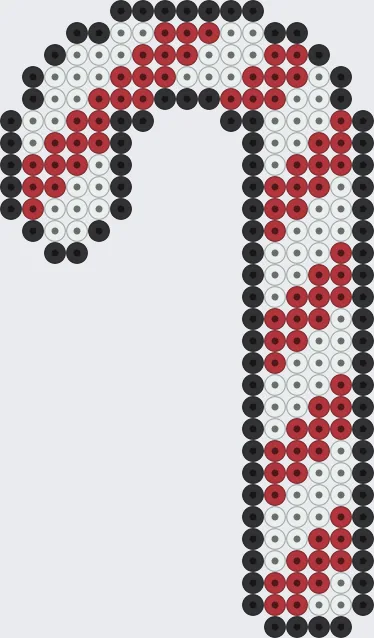
| Size | 17 × 29 beads |
|---|---|
| Colours | 3 · Perler |
| Total beads | 241 |
| Difficulty | Beginner (1/5) |
| Finished size | 3.3 × 5.7 in (8.5 × 14.5 cm) |
| Pegboards | 1 square 29 × 29 board |
| Licence | CC BY-NC 4.0 — free for personal use with credit |
Materials
About this design
The cane is four beads thick with a black outline, and its stripes run diagonally all the way along — down the long stem, over the hook and down the short end. Keeping every stripe on the same slant is what makes it look like a twisted stick of rock rather than a set of rings. With only three colours it is a calm, repetitive pattern that is easy to pick up and put down.
Bead counts: 86 Black, 78 Red and 17 White.
Placing the beads
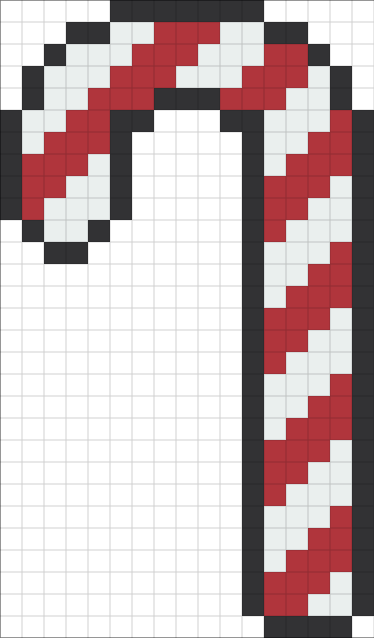
The candy cane is 29 rows tall but only 17 wide, so it runs the full height of a large square pegboard and leaves a strip down one side free for a small extra piece. Put the outline in first. Then do the stem a stripe at a time: each stripe is three beads tall in any one column, and moves up one bead as you go across. Once the stem is right, the hook follows the same rule.
Ironing and finishing
Ask an adult to iron it. Long thin pieces can warp, so iron with the paper held flat, use medium heat and keep the iron moving along the whole length rather than staying in one spot. Iron both sides, then cool it under a book. At about 8.5 × 14.5 cm it hangs nicely on a Christmas tree: thread a ribbon through one of the outline beads at the top of the hook. Several in a row also make a simple mantel garland.
Colour plan
Perler 80-19018 Black does the most work, 36% of the 241 beads, followed by Perler 80-19005 Red at 32%. Every colour is used at least 77 times, so there are no tiny one-off details to hunt for. 51% of the grid is left empty.
Working notes
All the beads touch along a full side, so it irons into one solid piece.
Hama and Artkal S equivalents
The nearest Hama and Artkal S colour for each Perler colour in this pattern, measured as ΔE 2000: up to 3 is very close, up to 6 close, up to 10 approximate.
This is an original CraftPatterns design, licensed CC BY-NC 4.0: stitch it, share it and gift what you make — please credit craftpatterns.app and don't sell the pattern itself. Want to change it? Open it in the fuse beads editor.
Last updated · About us