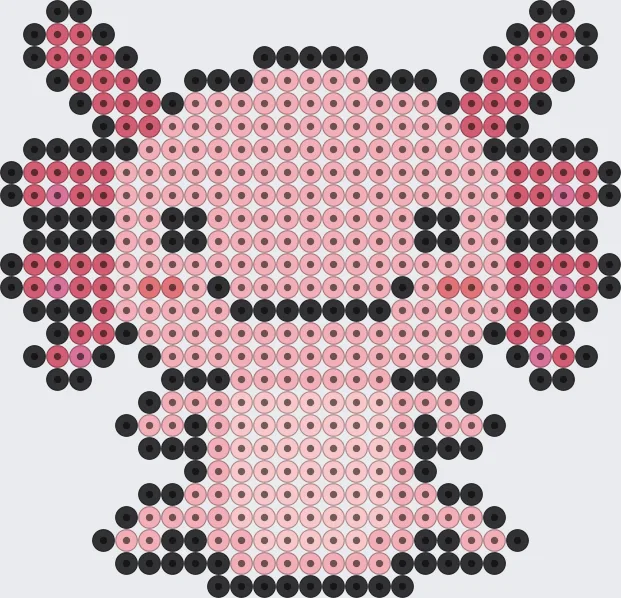
| Size | 27 × 26 beads |
|---|---|
| Colours | 6 · Perler |
| Total beads | 494 |
| Difficulty | Easy (2/5) |
| Finished size | 5.3 × 5.1 in (13.5 × 13 cm) |
| Pegboards | 1 square 29 × 29 board |
| Licence | CC BY-NC 4.0 — free for personal use with credit |
Materials
About this design
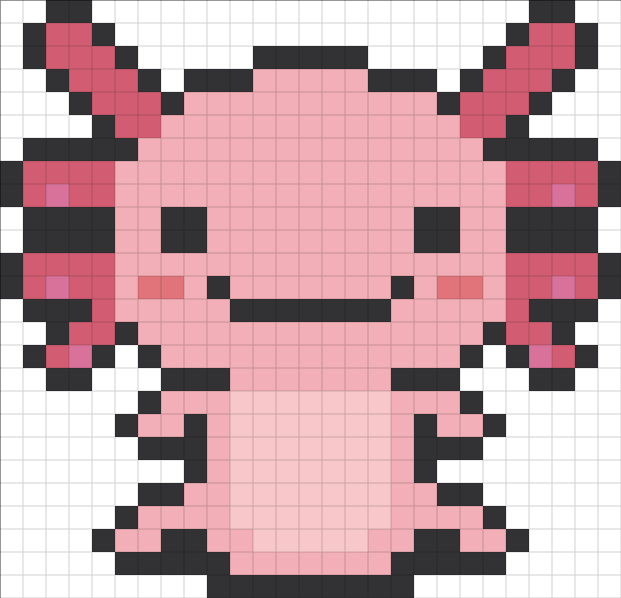
Axolotls are all about the gills, so they get the most room here: three Rose fronds fan out from each side of the wide head, with a few Bubblegum beads in the lower fronds for sparkle. The face is soft Flamingo with eyes set far apart, a straight little smile and Salmon cheeks. Below the head, a short body has a Carnation belly stripe, two stubby arms and two feet that poke out at the bottom. The whole pattern is symmetric left to right.
Bead counts: 220 Flamingo, 155 Black, 62 Rose, 47 Carnation, 6 Bubblegum and 4 Salmon.
Placing the beads
At 27 × 26 the axolotl uses most of a large square pegboard, so start one row down from the top and centre it carefully; count from the middle column outwards so both sets of gills land evenly. Lay the gill outlines first — the black beads between the fronds are what separate them — and fill the pink head afterwards. Flamingo and Carnation are close in shade, so keep them in separate trays.
Ironing and finishing
Ironing is for an adult. Pale pinks fuse quickly, so use medium heat, keep the paper flat and check after about ten seconds. The tips of the gills are only joined on one or two sides, so give them an even press on the front and again on the back. Cool it under something heavy for a flat finish. At about 13.5 × 13 cm it makes a fun coaster or a decoration for a fish-tank shelf.
Colour plan
Perler 80-15203 Flamingo does the most work, 45% of the 494 beads, followed by Perler 80-19018 Black at 31%. Perler 80-19006 Bubblegum (6) and Perler 80-15204 Salmon (4) are used only a little: small details worth marking on the chart so you don't miss them. 30% of the grid is left empty.
Working notes
All the beads touch along a full side, so it irons into one solid piece.
Hama and Artkal S equivalents
The nearest Hama and Artkal S colour for each Perler colour in this pattern, measured as ΔE 2000: up to 3 is very close, up to 6 close, up to 10 approximate.
| Perler | Hama | Artkal S |
|---|---|---|
| 80-19018 | H18 ΔE 9.6 · approximate | S13 ΔE 2.9 · very close |
| 80-15244 | H33 ΔE 9.9 · approximate | S132 ΔE 4.0 · close |
| 80-15203 | H95 ΔE 5.4 · close | S19 ΔE 7.1 · approximate |
| 80-19006 | H06 ΔE 7.0 · approximate | S130 ΔE 3.2 · close |
| 80-15204 | H44 ΔE 7.1 · approximate | S95 ΔE 7.8 · approximate |
| 80-15276 | H78 ΔE 10.0 · approximate | S19 ΔE 4.1 · close |
This is an original CraftPatterns design, licensed CC BY-NC 4.0: stitch it, share it and gift what you make — please credit craftpatterns.app and don't sell the pattern itself. Want to change it? Open it in the fuse beads editor.
Last updated · About us